
Back Workout Using Cable: Build Strength and Size

A back workout using cable machines is the most direct method for building back thickness and width because cables maintain constant muscle tension through every degree of the movement. Free weights lose resistance at the top of a pull due to gravity. Cables do not. That mechanical difference makes cable exercises for back development uniquely effective for hypertrophy, where constant tension drives more muscle fiber recruitment across both the concentric and eccentric phases. IFBB-level bodybuilders and certified strength coaches consistently program cable rows, pulldowns, and face pulls as the backbone of any serious back routine. This guide covers the anatomy, the best exercises, how to structure your routine by level, and the mistakes that quietly kill your gains.
What muscles does a cable back workout target?
The back is not one muscle. It is a layered system, and understanding which layer you are training changes how you set up every exercise.
The latissimus dorsi is the largest muscle in the upper body. It runs from the lower spine to the upper arm and creates the V-taper shape most lifters train for. The rhomboids sit between the shoulder blades and pull the scapulae together during rowing movements. The trapezius spans from the base of the skull to the mid-spine and controls scapular elevation, retraction, and depression. The teres major and minor assist the lats during pulling movements and add depth to the outer back. The posterior deltoids sit at the rear of the shoulder and are heavily recruited during face pulls and reverse flies.

Cable machines target all of these muscles with one critical advantage over free weights. Cables maintain tension through the full range of motion because the resistance comes from a pulley system, not gravity. A dumbbell row loses meaningful resistance at the top of the movement when the arm is fully contracted. A cable row does not. That sustained load forces the muscle to work harder through the stretch and the squeeze, which is the exact stimulus that drives hypertrophy.
Cable machines also allow multi-angle training that free weights cannot replicate as easily. You can pull from high, mid, or low positions without changing equipment. You can rotate your grip, swap attachments, and shift your body position to shift the load across different muscle fibers. That flexibility makes cables the most versatile tool for back training in any gym.
Which cable exercises build the most back strength and size?
The best cable back workout is built around a small number of high-return exercises, not a long list of variations. Here are the exercises that consistently deliver results.
-
Wide-grip lat pulldown. The gold standard for back width, the wide-grip lat pulldown targets the outer lats and builds the V-taper shape. Sit upright, grip the bar wider than shoulder width, and pull the bar to your upper chest while keeping your elbows driving down and back. Do not lean back excessively. The movement should come from the lats, not momentum.
-
Seated cable row. The seated cable row builds back thickness by targeting the mid-back, rhomboids, and lower traps. Use a neutral-grip handle and pull toward your lower sternum. Squeeze the shoulder blades together at the end of each rep. Avoid rounding the lower back as you reach forward on the return.
-
Single-arm cable row. Unilateral training corrects left-to-right strength imbalances that bilateral rows mask. Attach a single handle to a low pulley, brace your core, and row with one arm at a time. The single-arm setup also allows a greater range of motion and a deeper stretch at the start of each rep.
-
Straight-arm rope pulldown. This exercise isolates the lats without involving the biceps. Stand facing a high pulley with a rope attachment, keep your arms nearly straight, and pull the rope down to your thighs in an arc. The lats do all the work. This is one of the best finishing moves for a cable machine back routine.
-
Cable face pull. The face pull targets the rear deltoids, rhomboids, and external rotators. Attach a rope to a high pulley, pull toward your face with your elbows flared high, and separate the rope ends at the end of the movement. This exercise corrects the shoulder imbalances that heavy pressing creates.
-
Cable shrug. Attach a straight bar to a low pulley, stand upright, and shrug straight up. This isolates the upper trapezius with consistent resistance that a barbell shrug cannot provide at the top of the movement.
Pro Tip: IFBB pro Eric Janicki recommends 2 sets per exercise at 7–10 reps for advanced lifters, focusing on time under tension rather than maximum load. Beginners should target 3 sets of 10–12 reps to build the motor patterns first.
How do you structure a cable back routine by fitness level?
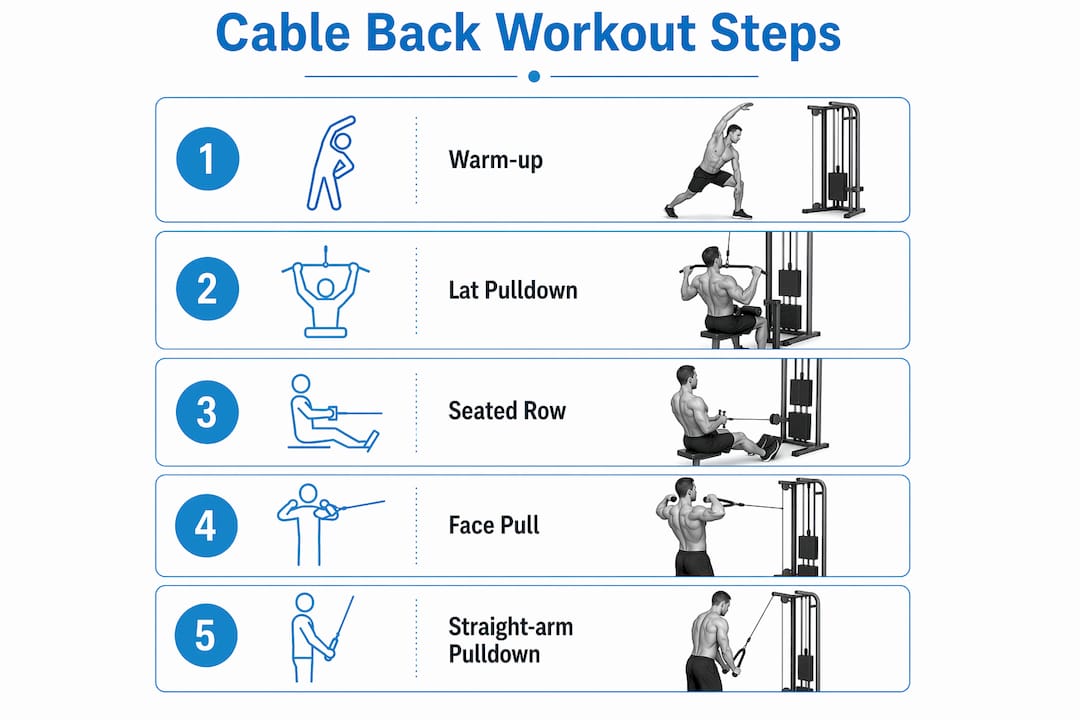
Routine structure separates lifters who make consistent progress from those who spin their wheels. The right volume, rep range, and exercise order depend on your training age.
| Level | Exercises | Sets per exercise | Reps | Rest |
|---|---|---|---|---|
| Beginner | 2–3 (seated row, lat pulldown) | 3 | 10–12 | 90 seconds |
| Intermediate | 4–5 (add face pull, straight-arm pulldown) | 3 | 8–12 | 75 seconds |
| Advanced | 5–6 (add unilateral work, angle variations) | 2–3 | 7–10 | 60–90 seconds |
Beginner lifters should start with 3 sets of 10–12 reps on two or three exercises. The seated cable row and wide-grip lat pulldown cover the full back effectively and teach the pulling pattern. Rest 90 seconds between sets. The goal at this stage is motor learning, not maximum load.
Intermediate lifters add a third plane of movement. A face pull or straight-arm pulldown rounds out the session and starts targeting the smaller muscles that beginners often neglect. Reduce rest to 75 seconds to increase training density.
Advanced lifters benefit most from angle variation and attachment changes. Using bench support or facing away from the cable stack shifts the pull angle and recruits different fibers in the lats, rhomboids, and rear delts. Swapping standard handles for cable cuffs removes grip fatigue from the equation entirely. At this level, the rep range drops to 7–10 with a slower tempo to maximize time under tension.
One principle applies at every level: start with the largest movement first. Pull the lat pulldown or seated row before you move to isolation work like face pulls or straight-arm pulldowns. Fatiguing the smaller muscles first limits how hard you can work the larger ones.
What mistakes ruin cable back workouts?
Most lifters leave significant gains on the table because of a handful of fixable errors.
-
Prioritizing load over form. Neglecting form to lift heavier weight is the most common mistake in cable back training. When the weight is too heavy, the biceps and shoulders compensate, and the back muscles do less work. Drop the weight and feel the target muscle working through the full range.
-
Cutting the range of motion short. The stretch phase of a cable row or pulldown is where a significant portion of the hypertrophy stimulus comes from. Stopping the movement early to handle more weight eliminates that benefit. Let the weight pull you into a full stretch at the start of every rep.
-
Letting grip strength limit the set. Grip fatigue fails before the lats do on heavy rows and pulldowns. Cable cuffs remove grip as the limiting factor and let the target muscles work to true failure. This is especially useful on lat-focused exercises.
-
Losing core stability on standing exercises. Standing cable rows and straight-arm pulldowns require a braced core. Without it, the lower back takes the load and the lats disengage. Brace before you pull and hold that tension through the entire set.
-
Ignoring breathing and tempo. Controlled reps with deliberate breathing extend time under tension and increase muscle activation. Exhale on the pull, inhale on the return, and count a two-second eccentric on every rep.
Pro Tip: If you cannot feel your lats working during a pulldown, try initiating the movement by depressing your shoulder blades before you bend your elbows. That cue activates the lats first and keeps the biceps from taking over.
Key Takeaways
Cable back training outperforms free weights for hypertrophy because constant tension through the full range of motion forces the muscle to work harder on every single rep.
| Point | Details |
|---|---|
| Constant tension advantage | Cables load the muscle through both the stretch and contraction, unlike free weights that lose resistance at the top. |
| Start with compound pulls | Program lat pulldowns and seated rows first to maximize output on the largest back muscles. |
| Match volume to your level | Beginners use 3 sets of 10–12 reps; advanced lifters drop to 7–10 reps with slower tempo and more exercises. |
| Use cuffs for isolation | Cable cuffs remove grip fatigue and let the lats and upper back work to true failure. |
| Angle variety prevents plateaus | Changing pull angles and body positions targets different muscle fibers and keeps progress moving forward. |
Why I think most lifters underuse cables for back training
Most gym-goers treat the cable machine as a finishing tool. They do their barbell rows and weighted pull-ups, then add a few sets of pulldowns as an afterthought. That ordering is backwards for anyone who has hit a plateau on free-weight back work.
Cables gave me something barbells could not: feedback. When you slow down a cable row and focus on the eccentric, you feel exactly which muscles are working and which are compensating. That feedback loop accelerates technique correction faster than any coaching cue. I spent two years adding weight to my barbell row without building a noticeably thicker back. Six weeks of cable-focused training with controlled tempo changed the shape of my upper back more than those two years did.
The other thing most lifters miss is angle variety. Pulling from a high pulley, a mid pulley, and a low pulley in the same session hits the lats, rhomboids, and lower traps in ways that no single barbell movement can replicate. I now pair one heavy free-weight pull with three or four cable variations in every back session. The free weight builds raw strength. The cables build the detail and the depth.
My honest advice: stop treating cables as supplemental. Build your back session around them, track your progress set by set, and you will see results that free weights alone were not delivering.
— Shelbe
Build your cable back plan with Gymdoe
Knowing the exercises is one thing. Having a structured plan that tracks your progress, adjusts to your level, and keeps you consistent is another.

Gymdoe is a workout tracking platform built for serious lifters who want their training structured, not just logged. You can build a full cable machine back routine inside the app, organize it into a multi-day plan, and track every set, rep, and weight in real time. Gymdoe’s AI-powered adaptation lets you take a proven cable back program from another lifter and reshape it around your equipment, schedule, and experience level. Personal best tracking and estimated 1RM insights show you exactly where your strength is growing. If you want your cable back training to be structured and measurable, Gymdoe is where to start.
FAQ
What is the best cable exercise for back width?
The wide-grip lat pulldown is the best cable exercise for building back width. It targets the outer latissimus dorsi directly and is widely recognized by fitness professionals as the primary driver of the V-taper shape.
How many sets and reps should I do for a cable back workout?
Beginners should perform 3 sets of 10–12 reps per exercise. Advanced lifters benefit from 2 sets per exercise at 7–10 reps with a slower tempo to maximize time under tension.
Are cable back exercises better than free weights for muscle growth?
Cables are superior for hypertrophy because they maintain constant tension through the full range of motion. Free weights lose resistance at certain points due to gravity, which reduces the stimulus during the stretch and contraction phases.
How do I stop my grip from failing before my back during cable rows?
Use cable cuffs instead of standard handles. Cuffs attach around the wrist and remove grip strength as the limiting factor, allowing the lats and upper back muscles to work to true failure.
How often should I train back with cables?
Training back with cables two times per week gives most lifters enough volume for growth and enough recovery time between sessions. Advanced lifters can add a third session if they manage total weekly volume carefully.